Just as every human body is unique, the processes that take place within it—including pregnancy symptoms—differ for each woman. A woman who longs to be pregnant naturally wants to recognize these signs and feel them as soon as possible. After all, pregnancy is such a wonderful, special, and unique time, isn’t it?
Pregnancy signs and symptoms—and how they manifest—can vary slightly or radically from woman to woman. While some women experience early signs indicating pregnancy, others do not notice any changes in their well-being.
Below, we describe the early signs of pregnancy. If you notice these signs, get checked at your local clinic, and if the pregnancy is confirmed, register with your doctor for pregnancy care.
Also, join our “Lalu — Pregnancy School”. To do this, download our mobile app for free from the Google Play app store. And follow your whole pregnancy with our wonderful pregnancy calendar!
Through the "Lalu — Pregnancy School" mobile app, you can take advantage of useful features such as tracking changes in you and your baby throughout pregnancy, viewing images and measurements that show fetal development, choosing a name for your future child, and exchanging thoughts and experiences with other pregnant women.
Early signs of pregnancy
After an egg is fertilized, a series of hormonal changes occur in a woman's body. Below, we will discuss the changes taking place in your body against the background of these hormonal shifts. Of course, to confirm a pregnancy, it is necessary to undergo tests such as checking hCG levels in the blood and an ultrasound examination.
Absence of menstruation and light bloody discharge
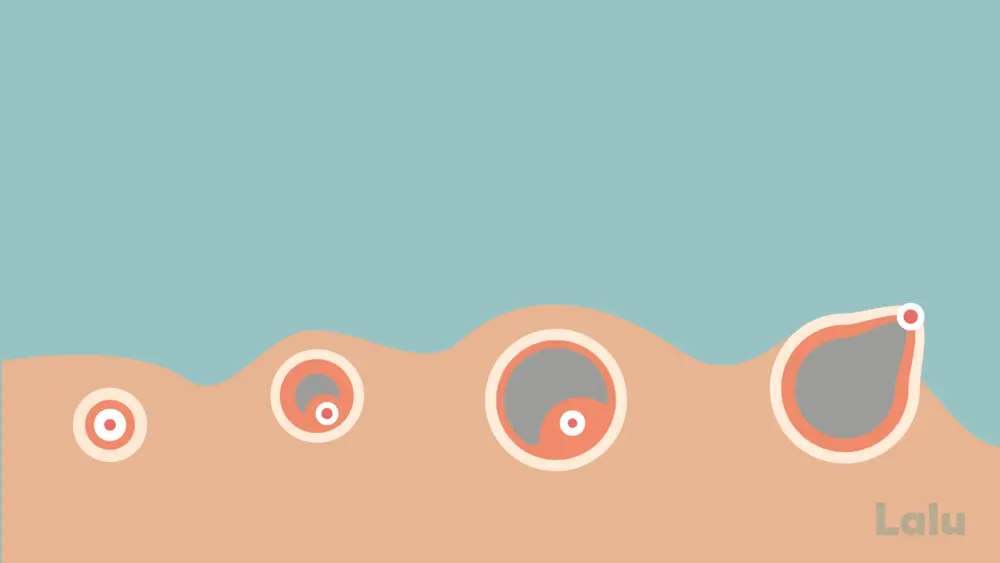
After fertilization, the egg begins to implant into the uterus. This process is called implantation. During this time (usually 1–2 days), a small amount of bloody discharge from the vagina may be observed. It differs fundamentally from menstrual bleeding in color, duration, and volume: the color is lighter, the duration is shorter, and the amount is very small. Menstruation does not occur at this time.
However, a delayed period should not be considered a reliable sign, as the absence of menstruation can often be associated with reproductive disorders, stress, and pathological hormonal changes.
You can find out what other factors besides pregnancy can cause delayed periods in this article: Causes of delayed menstruation
Signs of pregnancy: Breast enlargement and tenderness
When pregnancy occurs, many hormonal changes take place in a woman's body. The mammary glands are highly sensitive to hormonal changes. In the early days of pregnancy, the breasts become enlarged and the nipples tender. However, it should also be kept in mind that breast enlargement can occur due to hormonal contraceptives as well.
In addition, a pregnant woman’s breasts go through characteristic changes throughout the whole pregnancy. These changes begin with the very first signs of pregnancy and continue right up until delivery, until the breasts are ready to give the newborn complete nourishment.
You can learn more about breast changes during pregnancy in this article: Breast changes during pregnancy
Signs of pregnancy: Fatigue and drowsiness
Unexplained fatigue and tiring easily are also among the early signs of pregnancy. It is also common for some women to become emotional and tearful. This symptom often occurs during a first pregnancy.
An increased and accelerated metabolism in the body leads to feelings of fatigue, sleepiness, and a desire to rest. Interestingly, the drowsiness of the first trimester gradually turns into insomnia, often in the second and third trimesters.
Important: Cramps (spasms) during pregnancy
Nausea
Nausea or morning sickness usually begins at 5–6 weeks of pregnancy, but in some women this symptom may appear soon after conception, at 2–3 weeks. It should be kept in mind that nausea can also be caused by diseases of the gastrointestinal tract, cardiovascular system, and central nervous system.
You can learn more about morning sickness during pregnancy in this article: Morning sickness in pregnancy and ways to ease it at home
Increased urination
As an early sign of pregnancy, a woman may notice a need to urinate more often than usual. During pregnancy, the volume of blood in the body increases, so the pregnant woman’s kidneys have to process extra fluid. This, in turn, leads to an increase in urine output.*
It should also be kept in mind that frequent urination can sometimes be caused by other conditions, including a urinary tract infection, diabetes, or taking diuretics.
Signs of pregnancy – secondary symptoms
- An increase in basal body temperature as a sign of pregnancy;
- Due to the increased production of the hormone progesterone, body temperature may rise up to 37 degrees Celsius;
- Feeling a sense of heaviness in the pelvic area – blood circulation in this area increases, and the woman begins to feel pressure and heaviness.
- Insomnia – insomnia may occur because fatigue often leads to nervous excitability.
- Lower back pain – a dull, aching pain may be felt in the lower back area. However, pain can also occur with kidney diseases.
- Headache – headaches may occur because hormonal changes affect the nervous system.
- Dizziness. This can be linked to widening of the blood vessels, a drop in blood pressure and a drop in blood sugar. If you faint, be sure to tell your doctor. If fainting or severe dizziness comes with abdominal pain or vaginal bleeding, call an ambulance immediately, as it can be a sign of an ectopic pregnancy.
- Increased appetite – appetite increases against the backdrop of an accelerated metabolism.
- Heightened sense of smell and taste – if a woman previously did not pay attention to certain odors, sensitivity to smells increases during pregnancy.
- Irritability and mood swings – many women become short-tempered and experience frequent mood swings.
- Changes in body weight – weight gain occurs so that the female body can provide the fetus with nutrients.
- Swelling of the legs and hands – during pregnancy, the body holds on to more fluid, so mild swelling that comes on gradually in the legs, ankles and fingers can happen, especially in the later months. Sudden swelling of the face, hands or legs can be a sign of pre-eclampsia – if this happens, see a doctor straight away.
- Various facial breakouts – even if a woman previously had no skin issues, acne breakouts can appear on her face during pregnancy. This is explained by hormonal imbalance.
- Bloating and/or constipation – flatulence occurs in the intestines due to the effects of hormones on the bowel.
- Prominent veins in the breasts – after pregnancy begins, the body prepares for breastfeeding; the visibility of venous blood vessels indicates the onset of the lactation process. The color of the nipples also darkens.
- Flushing or redness of facial skin – blood vessels dilate as a result of hormones acting on the capillaries.
- Pigmentation changes along the abdominal midline—a symptom characteristic of pregnant women—appear as a "path" formed from the navel to the pubic symphysis.
If you are experiencing early signs of pregnancy but the pregnancy test shows a negative result, you may have tested a bit too early. Take the test again in a few days. If the test is still negative after two to three weeks, it is advisable to see a doctor to find out why your period has not come.
Once your pregnancy is confirmed, as we mentioned above,
install the “Lalu” mobile app on your phone. It will make the responsible task of bringing a healthy child into the world a little easier.
You can download the mobile app via this link: https://bit.ly/lalu-app