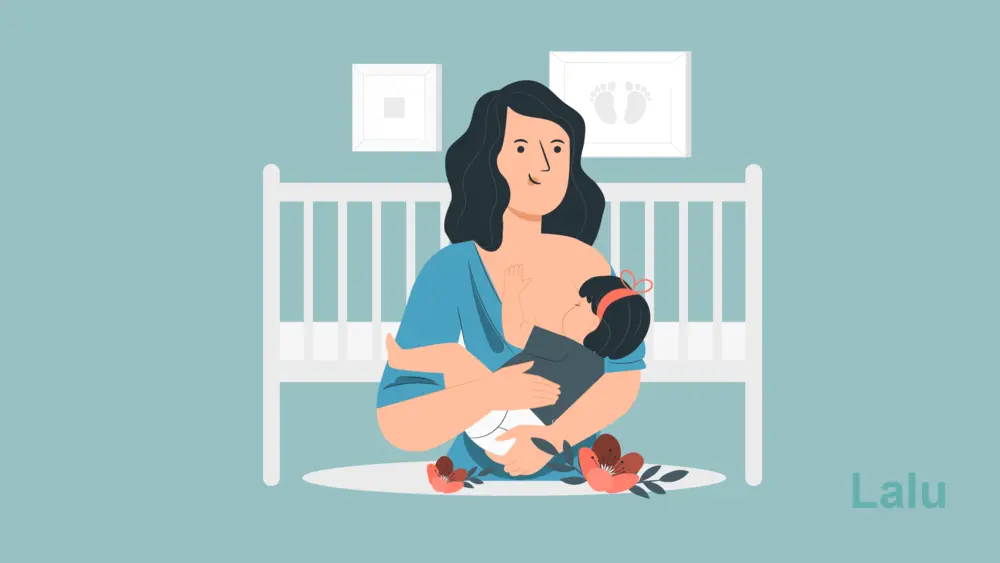
Between about 1 and 3 months of age, your child goes through exciting stages of hearing and speech development. These include smiling upon hearing your voice and turning their head toward sounds. During this period, children also begin to imitate certain sounds.
In this article, you will find detailed answers to questions such as “When will my baby talk?”, “At what age do children start talking?” and “When do babies say their first words?”
The sounds in your voice
Just as babies are naturally drawn to the human face over other visual patterns, your baby can also readily distinguish the human voice from other sounds. They primarily recognize and respond to the voices they hear most often. Babies associate voices with warmth, food, and comfort.
In general, babies prefer high-pitched voices—a fact that adults grasp intuitively and respond to accordingly without even realizing it.
Listen to yourself the next time you talk to your baby.
You will probably notice that you raise your pitch, slow down your speech, elongate syllables, and open your eyes and mouth wider than usual. This theatrical approach captures almost any baby's attention and usually brings a smile to their face.
By listening to you and others, your child learns the importance of speech, as well as how to clearly understand and repeat words. Within a month, they will be able to recognize you by your voice, even if you are in another room.
Important: Fever during pregnancy — causes, risks, and ways to bring down a fever
First communication
When you talk to your child, they calm down, find comfort, and enjoy these conversations. When your child smiles at you, they see the joy on your face and understand that the conversation goes both ways. Early conversations teach a child many subtle rules of communication, such as turn-taking, tone of voice, imitation, soothing, and the pace of verbal response.
At around two months of age, your baby will begin repeating certain vowel sounds (ah-ah-ah, ooh-ooh-ooh). During the first 4–6 months, imitate the sounds and noises they make, while also trying to use simple words and phrases in your "conversations."
Useful article: When does a baby stand or start walking?
Infant speech
In early infancy, you should read to your child, even if you think they won't understand. By four months of age, your baby will begin babbling regularly, often amusing themselves for long periods by making strange new sounds (muh-muh, bah-bah). They also become more sensitive to the tone of your voice and the emphasis you place on words or phrases.
As you spend time together each day, they can tell from your voice when you are going to feed them, change their diaper, take them for a walk, or put them to bed.
Your talking tells them a lot about your mood and personality, and their responses to you also reveal a great deal about your child. If you speak to your baby in an upbeat or comforting tone, they may smile or laugh. If you yell at them or speak in an angry tone, your child is much more likely to become frightened or cry.
Good to know: What should you do if there is blood in a child's stool?
When does a child start talking? (Age milestones)
Considering that your baby can hear even during pregnancy, they have full hearing ability after birth. As the baby grows and develops, their age-appropriate hearing and responses to sounds also change. However, hearing problems may be suspected in children who do not respond to sounds or whose language skills do not develop accordingly.
The table below is meant for every parent who wonders “When will my child start talking?” It contains some age-related information that can help you determine whether your child has a hearing problem.
Speech and hearing milestones
It is important to remember that not all children are the same. Children reach milestones at different ages and times. If you think your child is not hearing well or you have concerns about their speech skills, have them examined by a pediatrician or an ENT specialist.
Information from stanfordchildrens.org and www.healthychildren.org was used in preparing the article, and it was compiled by the "Lalu" team.