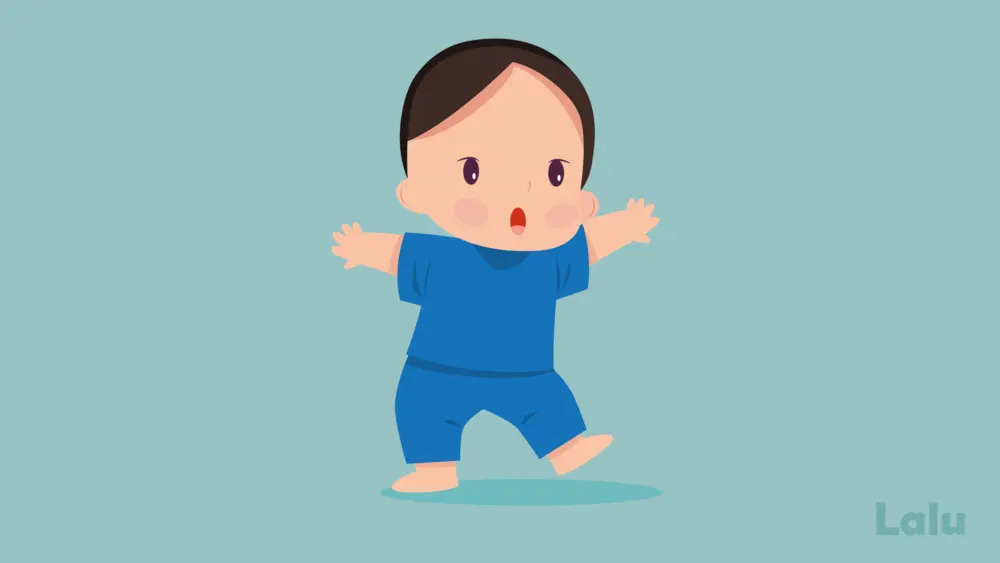
Seeing things from above can be very exciting for your child! Learning to stand opens up another new world for them, and this milestone is very important for their independence. At the same time, it is a very exciting and joyful event for parents when a child stands on their feet or tries to do so.
When will my child stand up?
Before your little one can stand on their feet, they need to develop muscle strength and be able to coordinate it, and learning to roll over and sit up first will help them with this.
At around six months of age, your child will be able to sit with your help, and by seven or eight months, they can sit comfortably on their own. At this stage, you should help your child stand up by gently pulling them up and supporting them. Then you can enjoy watching the process of your child taking their steps.
Between seven months and one year, your child should try to pull themselves up. They may stand for a few minutes before falling backward (sitting down) with a slight bump.
Useful: Sleep norms and the benefits of sleep for children
When will the baby stand on their feet?
From birth, your child has the reflexes necessary for "standing," firmly planting their feet on the surface they are touching. If you hold your newborn upright on your lap while supporting their head, you will feel them gently pushing against your legs.
By three months of age, this reflex changes and your baby begins to bear weight on their legs. Naturally, your child does not have enough strength to stand at this time, so if you hold them upright and place their feet on the ground, their knees will sag.
Over the next few months, the child develops the strength to support their own weight and keep their feet on a solid surface; at this stage, they might even bounce up and down.
By the time your child is six months old, if you help them stand up, they will be able to support their own weight.
Between seven and twelve months of age, your child will begin trying to stand up by holding onto furniture or an object in the room.
By seven months, their muscles will have enough strength to stand up, but they will not be able to maintain their balance.
If you place your child next to a sofa, they will hold onto the arm of the sofa to help maintain their balance. This is their first big movement.
You can ensure your child's safety by clearing the area of toys and sharp objects, and by placing pillows on the floor so they can land more safely in case they fall.
Learning to fall is an important part of mastering standing and walking. You can see this behavior starting around your child's sixth month.
At nine months, you may notice that it is becoming easier for your baby to stand up. However, they are still unable to get back down smoothly; instead, they may sit down with a slight bump.
When your child pulls themselves up using furniture, they initially stand on their tiptoes. With some practice, the child will eventually stand flat on their feet, which leads to a more stable position.
Between ten months and one year of age, approximately by the age of one, your child may be able to stand independently. The child will even begin to learn how to bend their knees and sit down after standing.
This process, like all stages of a child's development, can be challenging! And the early stages of a child's development require attention and responsibility from parents. This is because deviations from the norm or neglect can lead to developmental delays.
Download the "Lalu" mobile app to track these and similar developmental stages and monitor your child's normal changes.
Interesting: Child development stages: Hearing and sound production
If the child doesn't stand on their feet…
If your baby does not try to bear weight on their legs and stand up before the age of one, or if you are concerned about their current development, tell your doctor. All babies develop skills differently, some faster than others, some slower.
Keep in mind that if your baby was born prematurely (before 37 weeks of pregnancy), they may reach these and other important milestones a little later than other babies.
Good to know: How to soothe a baby crying in their sleep?
Developmental delays
While it is normal for important milestones to be reached a little earlier or later, sometimes delays are not typical and may be due to a medical reason. Sometimes important milestones, such as a baby taking steps (or others), are not observed for weeks or even months after the usual time. When this happens, it is considered a developmental delay.
When you take your child to the pediatrician, the doctor will assess whether they have reached these milestones. If your child's skills are outside the norm, the doctor will determine if there are underlying medical issues causing the condition.
Some medical issues that can cause delayed standing or walking include:
- Down syndrome;
- Cerebral palsy;
- Congenital orthopedic problems;
- Muscular dystrophy.